Thanks for stopping by our blog! We are no longer updating this site, so if you want to see the latest from SocialSnakes, head on over to SocialSnakes.org where this blog is now hosted.
Showing posts with label Cap Mama. Show all posts

Happy Mother's Day!

Sunday, May 12, 2013

Mother's day is a much bigger deal than Father's day. Why? Well, there's just something extra special about mom (sorry Dad!). So, today's post is about an under-appreciated group of moms (you guessed it), Arizona black rattlesnakes!


Human moms - you think you have it tough? Rattlesnake maternal duties may only last a couple weeks, but during that time they may have to protect their kids from extreme temperatures, a suite of predators, annoying (and deadly?) squirrels, and clumsy humans with cameras... By the time they give birth, mother rattlesnakes likely haven't eaten in weeks or even months, but they wait another couple weeks to give full attention to their newborns. So here's to you rattlesnake mommies!

We'll start with the most famous of all, Cap Mama, who showed us what a typical day is like for a new rattlesnake family:

For an explanation of the behaviors seen in that video, check out this post.


What a beautiful family she has!

Sigma may have been one of our smaller mothers, but what she lacked in size she made up for in bravery:

Check out the full story of Sigma's squirrel battles here.

We've been lucky enough to see Woody and Alice with two different litters.
alice
Alice's family, 2010

alice
Alice's family, 2012


Woody's family, 2012. You can watch more timelapse videos of Woody's family here and here.

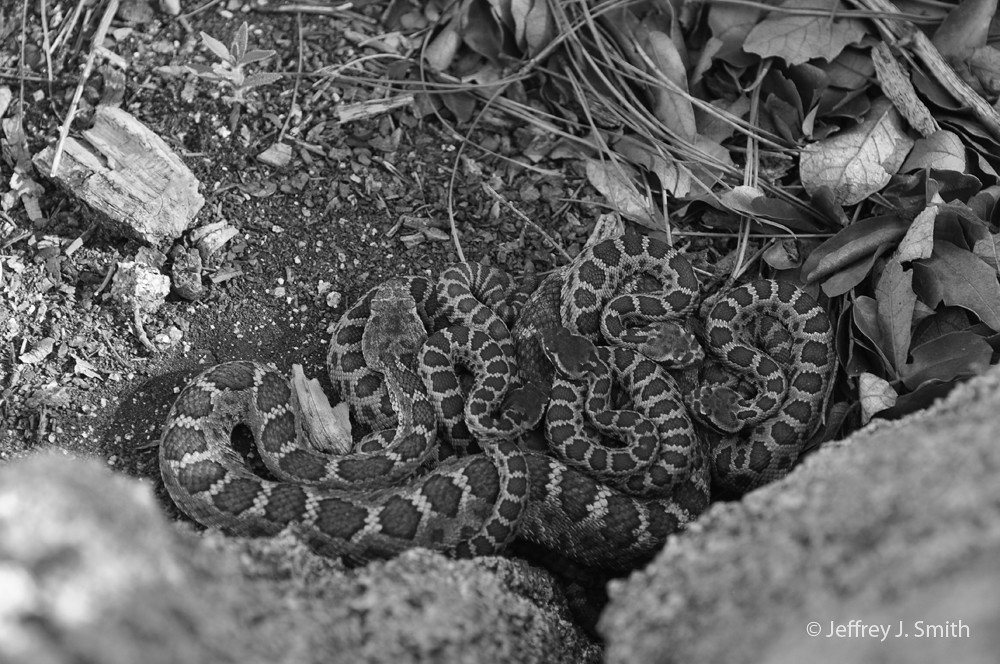
Every mom needs a day off. So the lucky (or smart?) rattlesnakes that nest in groups help each other out with maternal duties. If one is still pregnant, and thus needs to be on the surface basking, she attend to the newborns while the new mother stays in cover for a well-deserved rest. Priscilla was the first rattlesnake we observed exhibiting this baby-sitting behavior.
You can read more about Priscilla and House here.

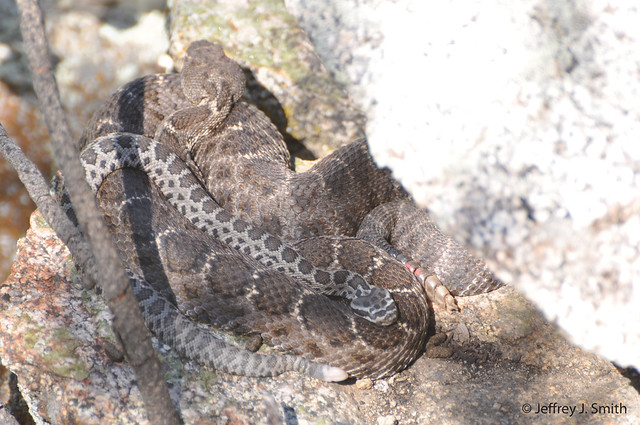
Male rattlesnakes occasionally help out in this way too. Although we've never observed any active care or protective behavior from males, just the presence of a large rattlesnake may be enough to deter some predators.

Still image of the group:

Green Male (adult male) is the large black rattlesnake at the top of the image and the mother (Devil Tail) is the smaller, brown adult (mostly her tail and rattle are visible).


A handful of newborns follow Roger (adult male) out of the nest entrance to a preferred basking spot.

Sometimes the youngest (smallest) mom gets stuck with the surface duties of caring for the newborns. Eve was the smallest of the pair of snakes that nested at this site; we saw her often on the surface with way too many babies to have all been her own. The older (larger) female was rarely seen on the surface with the newborns.


This is the first Mother's day in years that we haven't spent at dens with our rattlesnake mothers-to-be. But, as of last week, two (Persephone and Luna) of our three Muleshoe rattlesnakes are still near their dens. While this is atypical rattlesnake behavior in general, it is characteristic of pregnant Arizona black rattlesnakes. So maybe we'll have a couple more names to add to this list next year!

Drinking

Sunday, February 19, 2012

CapMama drinking
Cap Mama takes advantage of some rain to take a drink of water dripping off the rock above.

Drinking is a behavior rarely seen in wild snakes. In fact, some would say that snakes don't need to drink. While it is rare to see this behavior, snakes do drink and likely need water in addition to what they acquire from their food. How important drinking is to snakes became very clear to me one day in March 2006 (Repp & Schuett 2008). Despite cold, rainy, windy, and even snowy weather, we saw more than a dozen western diamond-backed rattlesnakes drinking rain and snow outside their dens!

A poor quality video of rattlesnakes drinking snow during the long, dry winter of 2005-2006. Ugh - glad we have upgraded our cameras!

Last summer was pretty dry at our field site; the monsoon did not amount to much. In the photo at the top of this post, you can see Cap Mama snagging a drink about nine days after giving birth. The following videos were taken by our time-lapse cameras while the snakes were still pregnant:

This is Cap Mama again, about a week before she gave birth. Shortly after the rain starts, she emerges and drinks rain as it falls on her body.


Meanwhile on the other side of this rock outcrop, another pregnant female (Stache) also sneaks out for a drink. Unfortunately there is some grass in the way, but you can still get an idea of what a drinking snake looks like.

For more information on drinking and water harvesting in snakes, check out this paper:
Repp, R.A. & Schuett, G.W. 2008. Western diamond-backed rattlesnakes, Crotalus atrox (Serpentes: Viperidae), gain water by harvesting and drinking rain, sleet, and snow. Southwestern Naturalist 53: 108–114.

A day in the life of a rattlesnake family

Friday, October 28, 2011

5 comments

Rattlesnakes take care of their babies.

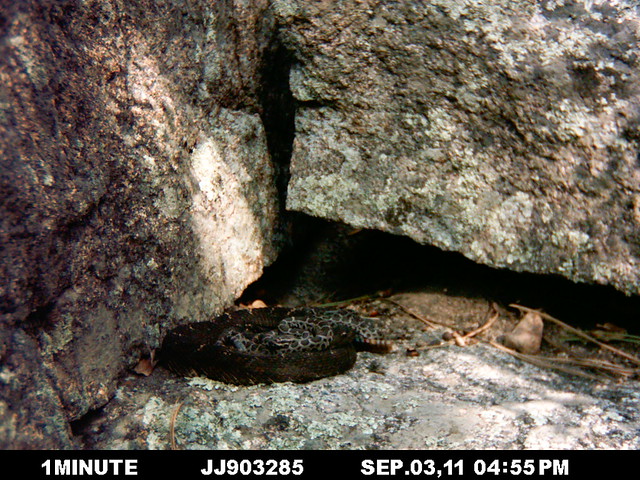
Yep, they really do. But, what does "care" look like in a snake? Do they feed their young like a mother bird? Do they keep them warm? Do they protect them from predators? With the exception of feeding, rattlesnakes care for their offspring in familiar ways. The following is a timelapse video (taken at 1 minute intervals) that illustrates a typical day for a new rattlesnake family. The large, black snake is Cap Mama, a female Arizona black rattlesnake that gestated with four other females and gave birth in late August to seven neonates. This video was taken when the neonates are just two or three days old.


Now let's look a little closer at some of the behaviors in the video:

WSPC0916
Before the neonates emerge for the day, Cap Mama looks out as if making sure it is safe for the neonates to come out. Here she looks toward the camera...


WSPC0917
And then she looks away from the camera. We have observed this "lookout" behavior by several different females.


WSPC1313
The neonate in the foreground of this photo is starting to stray from the group and Cap Mama notices.


WSPC1314
A gentle tap from Cap Mama reminds the neonate to stay with the group. We have also observed the females blocking neonates from straying too far (see A rattlesnake helper?).


WSPC1315
The neonate responds by returning to the group and Cap Mama heads back in as well.


WSPC1418
In this rattlesnake species, adults are darker than neonates and thus may be able to gain heat easier. By allowing neonates to sit on and near her, Cap Mama may be provisioning her offspring with heat (rattlesnakes are ectotherms: they depend on their environment for heat instead of producing their own like we do). And Cap Mama's larger size means she'll garner and release heat, perhaps even into the night when the family is tucked away in their refuge. Keeping warm helps a young snake develop, shed, and get ready to leave the nest and hunt on its own.