Thanks for stopping by our blog! We are no longer updating this site, so if you want to see the latest from SocialSnakes, head on over to SocialSnakes.org where this blog is now hosted.

Survivors

Sunday, January 29, 2012

It is always a little sad to say goodbye to the rattlesnake families at the end of the nesting season. It’s a difficult time for the neonates (newborns); in this population they have less than a month to find their first meal and locate a safe place to spend the winter. That’s a tall order for a two week old snake. So when the little ones disperse from the nest, we can never be sure that we’ll see them again. Today, we share stories about some of the lucky (or skillful?) neonates that survived that first winter.


Slide22
Eve (large brown female rattlesnake) nested with another female, Peach (not pictured), in 2010. Together they cared for about 10 neonates, although Eve was the one most often seen on the surface with the little ones. Above you can see Bozo basking with Eve in August 2010.

Slide23
Fast forward to April 2011, when the rattlesnakes are emerging from their den. Here Eve is captured by our timelapse camera coming out to bask.

Slide24
Bozo follows about 20 minutes later. They crawled onto a pile of leaves in the sun:

After basking a bit with Eve, Bozo gets restless and heads off camera. A little while later, Eve appears to notice he’s gone, searches for and finds his trail (note how her head is tapping the ground), and heads off in the direction he left.


DSC_3005
Another neonate from Eve and Peach’s nest we called Dagger. We haven’t thoroughly examined all the footage from the timelapse cameras, but so far, we have not seen Dagger at the dens in Spring 2011. So either we’ve missed him or he did not den with his nestmates, because….
Dagger
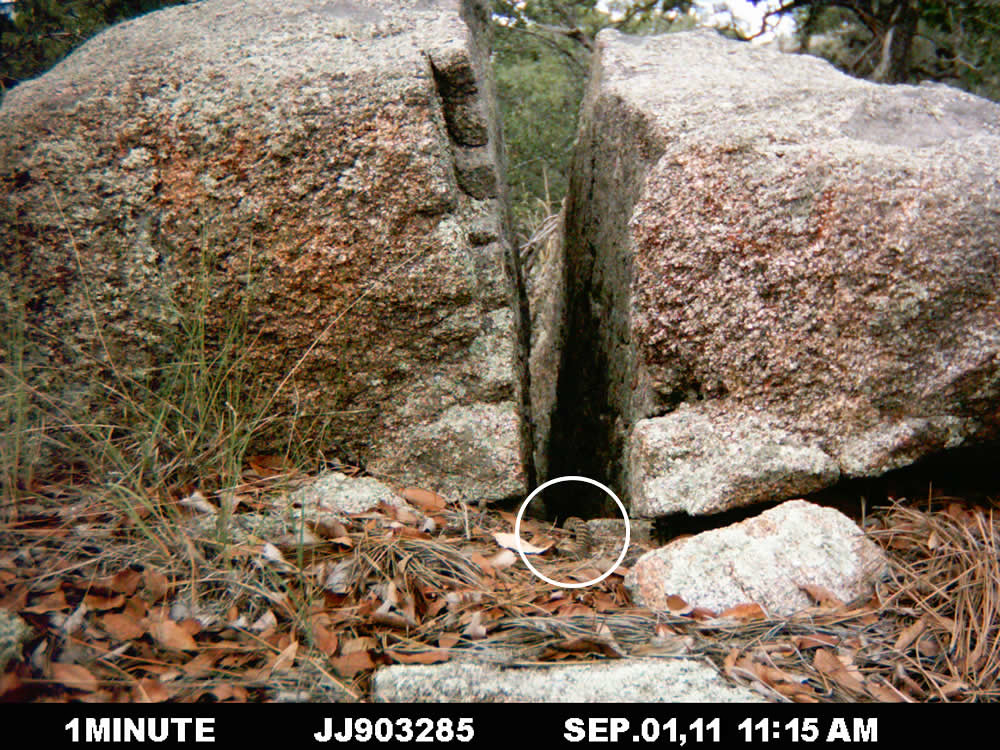
Dagger was hunting near the dens in late August 2011. He hung around the area for at least a week, trying out several different spots to get a meal. Then on 1 September, our timelapse camera caught him crawling into the rear entrance of Cap Mama’s nest (she gave birth that day).
dagger
dagger
Unfortunately that is the only footage we have of Cap Mama's nest that day, so we don't know if Dagger interacted with her or the neonates.


Slide20
The photo on the left is of Adam (neonate on left) and Woody (right), his mother. Woody's nest was farther away than most in 2010, about 150 yards from her den. Regardless, Adam found his way to the den where we saw him in April 2011 (photo on right). Our timelapse camera caught Woody and Adam as they basked together that day:


DSCN2004
This is Devil Tail, who nested alone at her den in 2010. Shortly after she gave birth, a large male rattlesnake, who also dens here, visited and basked with the family:
Still image of the group: DSC_3845
The adult male is the large black rattlesnake at the top of the image and Devil Tail is the smaller, brown adult (mostly her tail and rattle are visible). Both of the neonates pictured here were seen at the den the following spring (2011).
C520
Above is '520' in April 2011. Hopefully he'll be adopted and named soon!

unibrau
And this is Unibrau in April 2011. Unibrau was adopted by Bill Rulon-Miller - thanks!

Sigma & Barb
Barb, another of Devil Tail's neonates, is pictured here with Sigma in April 2011. Perhaps nesting right at the den increases your chances of surviving your first winter, because Devil Tail's kids seem to be doing pretty good!

If you enjoy reading these blog posts, please check out our project on RocketHub and support us financially or by spreading the word. We're raising funds to examine relatedness of this population of rattlesnakes, which will enable us to answer many questions our work has raised, including:
Are Peach and Eve, who nested together in 2010, sisters? Aunt and niece? Mother and daughter?
Was the male that visited Devil Tail the father of her neonates? Their uncle?

Supporting a research project might sound expensive, but it doesn't have to be. Through RocketHub, you can chip in as little as $5 to help us out. So skip one beer/wine/starbucks and support some cool snake research instead! Plus, you can get some cool snake stuff: rattlesnake photos, greeting cards, or adopt your very own social rattlesnake!

OK, maybe you don't have $5. But, it only takes a minute to share the link to our blog or RocketHub project on Facebook or Twitter. You have a minute, don't you? Thanks for whatever you can do to support SocialSnakes!

Support Social Snake Research!

Monday, December 19, 2011

0 comments


Are snakes social? YES! Do snakes live in groups? SOMETIMES! Are these groups of snakes extended families? Help us find out!

As a reader of this blog, you already know that rattlesnakes are quite gregarious. Their social lives are complex; they recognize and preferentially associate with their siblings, care for their kids, and even help care for their neighbor’s kids. But the big question remains unanswered.

Many of us who monitor rattlesnake dens have speculated that they are composed of closely related individuals. Our goal is to explore this idea by examining relatedness with microsatellite DNA markers. With your help, we will find out if dens really are a rattlesnake family reunion. Our research might reveal a previously undocumented, complex social system in snakes and promote snake conservation by highlighting some very human-like behaviors.

You know you're curious about the relatedness of the snakes you've been reading about here! Check out our project on RocketHub.

And spread the word! This can be just as helpful as a financial contribution.

Sigma vs. the squirrel

Friday, December 16, 2011

0 comments

Squirrels and rattlesnakes have a complicated relationship. Some squirrels have developed resistance to rattlesnake venom so that an adult squirrel can survive a rattlesnake bite. Juvenile squirrels cannot, so they are often still prey to rattlesnakes. Because of their resistance, adult squirrels will confront rattlesnakes that wander near their colonies and sometimes even kill them!

For more information on rattlesnake-squirrel interactions, check out research from Rulon Clark’s lab and his student Bree Putman’s blog. Now on to Sigma’s story…

We first met Sigma on 23 April 2011 when she was basking near her den. She was named for one of her many weird blotches that is shaped like the Greek letter. DSC_0337 Sigma and Barb, 24 April 2011. Barb was born here, to another female (Devil Tail), the previous September (2010).

6 August: We return to the dens and find Sigma at large rock near her den that will be her nest site. Toward the end of her pregnancy, she settles on the west side of the rock as her main basking area, so we set up a timelapse camera there.

Between 3 and 4 September, the squirrel appears to be investigating the nest rock, but never when Sigma is on the surface.

On 5 September, Sigma and the squirrel meet: WSPC2058 Sigma (at end of arrow) emerging for the first time that day

WSPC2059 The squirrel confronts Sigma

WSPC2060 Sigma immediately retreats beneath her nest rock

6 September: Sigma sticks her head out and looks around before emerging (like Cap Mama ). About an hour later, the first of her four neonates emerge from beneath the rock: WSPC2697

The following video captures Sigma’s family’s first day together (warning: its kinda long, 4 minutes). Watch for the squirrel’s appearance at 12:14PM.


The squirrel does not return (that we can see) the following day and the family spends most of it on the surface: WSPC4661

WSPC0226

Timelapse video of 8 September:


What starts as a peaceful day for the family was rudely interrupted by the squirrel at 11:27AM. Just before the squirrel appears in the video, Sigma turns and assumes an S-coil defensive posture typical of rattlesnakes: WSPC0295 Sigma at rest with her family

WSPC0296 Sigma turns, expands her body to look as large as possible, and assumes a ready-to-strike (S-coil) defensive posture.

What you can’t see in the video was captured by our overhead camera; Sigma is posturing to the squirrel just off screen: MDGC1954

The family immediately disappears; Sigma reemerges only after the squirrel is gone. The first neonate to emerge is quickly chased back under the nest rock by the squirrel (~11:54AM–12:01PM in the video).

9 September: After the squirrel interactions, the family seems to spend much less time on the surface (at least where the cameras can see). We recorded only one additional, indirect, interaction between Sigma and the squirrel:
As it often did when there weren’t snakes visible, the squirrel appears to be looking underneath the nest rock. Sigma returns, takes on the familiar defensive posture and appears to be rattling – although it’s difficult to be certain because the timelapse photos were taken at one-minute intervals.

Our camera continued to record at this location until 18 September and the squirrel returned about every other day, usually looking underneath the nest rock. Sigma and her four neonates were never seen together again, but we cannot say if they changed their behavior or if one or more neonates were injured or killed. One limitation of remote photography is that our knowledge is limited to what happened in view of the camera. However, it is unlikely that any of these squirrel-rattlesnake interactions would have occurred if a human observer was present. We never saw anything like this when we monitored rattlesnake families in person – have you?

Basiliscus Family Values

Friday, December 9, 2011

0 comments

You didn't think that Arizona black rattlesnakes were the only ones to take care of their kids, did you?

Crotalus-basiliscus-08271 by Young Cage

In a recent post on the Field Herp Forum, my friend Young Cage describes a series of observations of a family of Mexican West Coast Rattlesnakes (Crotalus basiliscus) . Young is an excellent photographer, so the post is worth checking out just to look at the pictures.

Podcast on social rattlesnake behavior

Friday, November 18, 2011

0 comments

If you'd like to take a break from reading, but not rattlesnake behavior, check this out:
The Reptile Living Room: Rattlesnake Behavior with Dr. Rulon Clark

This is a great interview with my friend Rulon Clark about his research, including social behavior of timber rattlesnakes. Dr. Clark is now a professor at San Diego State University, where his lab continues to do cool stuff with rattlesnakes and other reptiles (for example, check out Strike, Rattle, & Roll).

Scenes from a new den

Saturday, November 12, 2011

We were recently told about a new social rattlesnake den in the Galiuro Mountains. We hiked in to check it out, saw one western diamond-backed rattlesnake (Crotalus atrox), and decided to set up one of our timelapse cameras. The video below is from the first two days of our monitoring, and we were a little surprised at all the activity:


That video is a little long and it’s easy to miss all the visitors, so here are stills of all the reptiles we spotted.

WSPC0617

WSPC0618

WSPC0619
This is a juvenile Sonoran whipsnake (Coluber bilineatus). The closely related striped whipsnake (Coluber taeniatus) often shares dens with Arizona black rattlesnakes (Crotalus cerberus; see Are aggregations of Arizona black rattlesnakes stable and complex social groups?).


WSPC0672

WSPC0673

WSPC0675
A gila monster (Heloderma suspectum)! It is not unusual for Gila monsters to share dens with western diamond-backed rattlesnakes and Sonoran Desert Tortoises (Gopherus morafkai). However, this Gila checks out the den only to turn around and leave. Could it be looking for a date? It's awfully late in the year for Gilas to be out and about.


WSPC2029

WSPC2030

WSPC2031
Patch-nosed snake (Salvadora spp.) This is not a snake we have yet seen in any of our other dens. In this video, the patch-nosed appears to be checking the den out before moving on. Future videos may show if this snake continues to use the den.

There were a couple feathered reptiles here too (birds). Did we miss anyone? Who else will show up at the new den? Stay tuned...

Stop Roundups!

Friday, November 11, 2011

0 comments

Sorry for the interuption from our regularly scheduled program, but this is important.
Enjoy our blog posts?
Like snakes?
Then consider signing this petition to stop the unnecessary and cruel rattlesnake slaughter:
Ask Texas Department of Parks and Wildlife To End Rattlesnake Roundups