Thanks for stopping by our blog! We are no longer updating this site, so if you want to see the latest from SocialSnakes, head on over to SocialSnakes.org where this blog is now hosted.

Pretty in Pink

Wednesday, May 25, 2011

2 comments

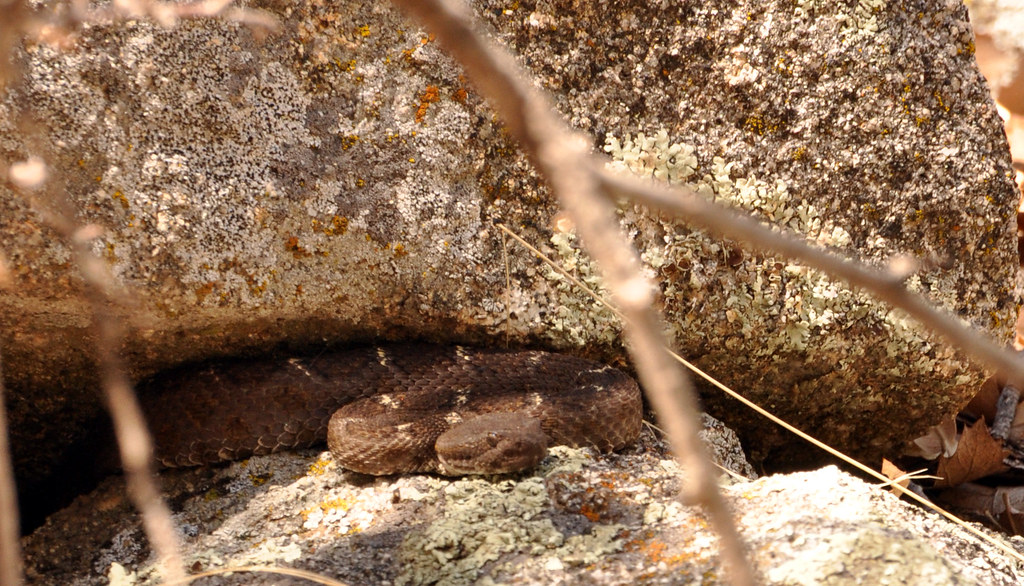
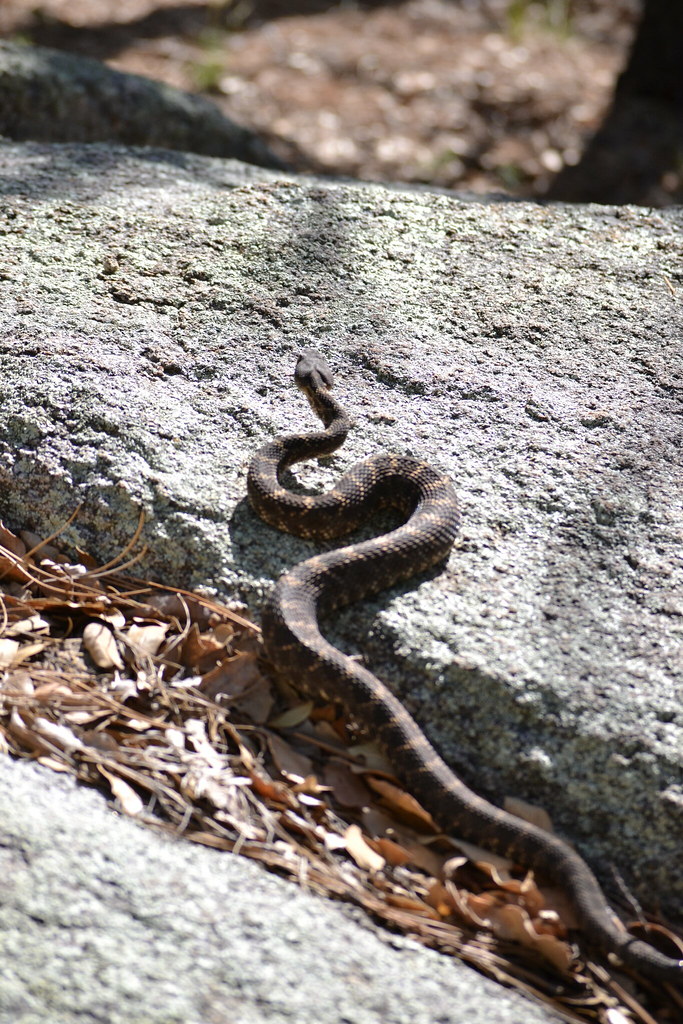
28 April:  Molly basks briefly before leaving the security of the den to fulfill what is on every rattlesnake’s mind: the first meal of the year. It’s been over seven months since they’ve last had a chance to eat, so they’re probably quite hungry.


Molly comes out first and coils on the left. The snake on the right is Freckle, another young adult female.


Fortunately, they need not travel far, at least at first; there’s an abundance of lizards, birds, and small mammals active around the dens when the snakes emerge in spring. Molly first moves to a rock about 6 meters south of the den entrance and sits in an ambush posture for a couple of hours before retiring for the evening.

The next day, after basking in the morning sun, we find her moving among branches and rocks, and take the opportunity to swab some pink paint on her rattle using a telescoping fishing rod. Although we are able to use blotch pattern irregularities to identify individuals, a little paint on the rattle further facilitates future identification. She appears unperturbed by this, and continues her meandering to a rock several meters further from the den. Over the next two days we see Molly using the same rock for hunting by day and shelter by night.


7 May:  Molly is nowhere to be found. In the spot where Molly was last seen is the unmistakable reek of skunk. While humans may perceive rattlesnakes as fierce predators, they are killed and eaten by a variety of birds and mammals, including skunks. While waiting for her first meal, did Molly fall prey to a skunk?

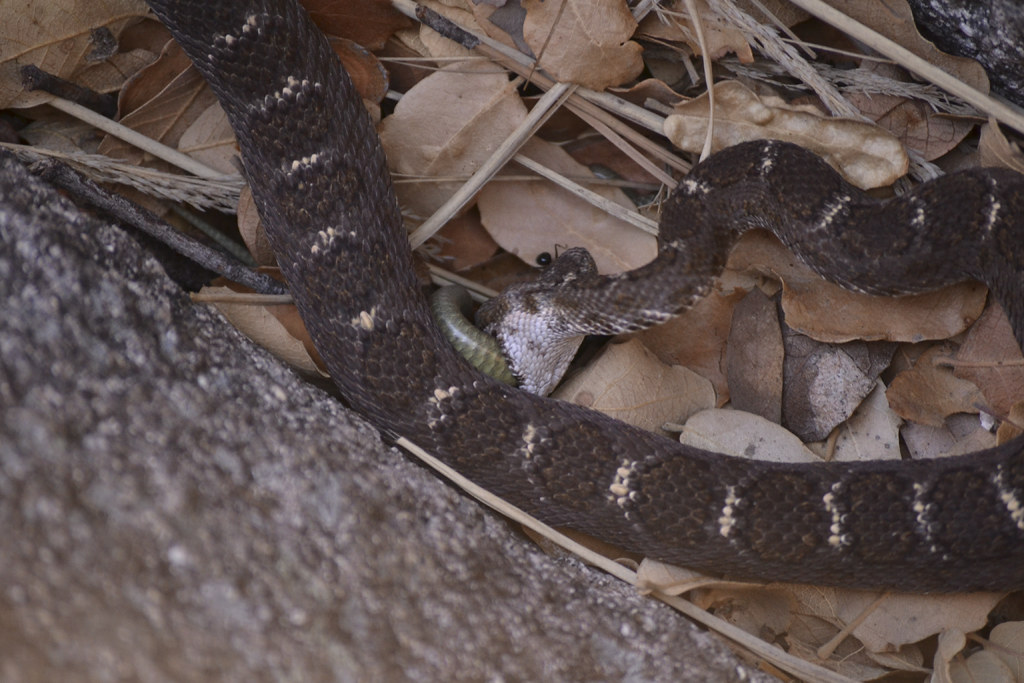
12 May:  We spot Molly on the west side of the den, stretched out in leaf litter, poking around in the leaves with her snout. At first the behavior seems quite unusual, but then we notice a long, smooth, tail poking out of the leaves.


We are then able to capture on video a rare observation of a snake feeding in the wild and thus document the first reported predation of a Gilbert’s Skink (Plestiodon gilberti) by an Arizona black rattlesnake.


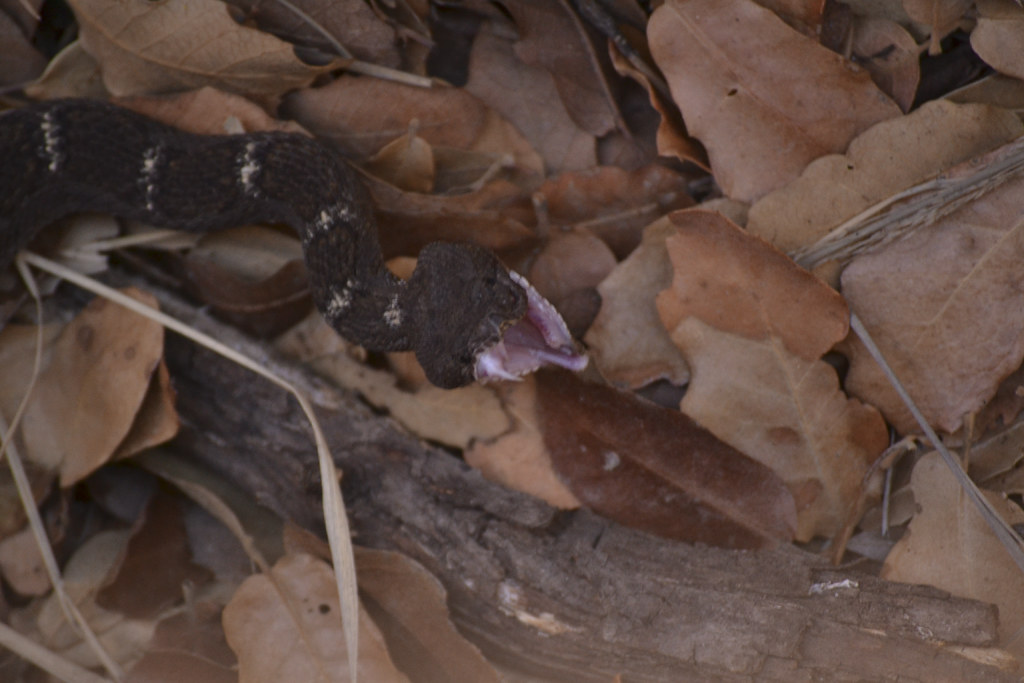
An after dinner yawn:


To see more pictures of Molly, click here

She's back: Alice!

Thursday, April 28, 2011

0 comments

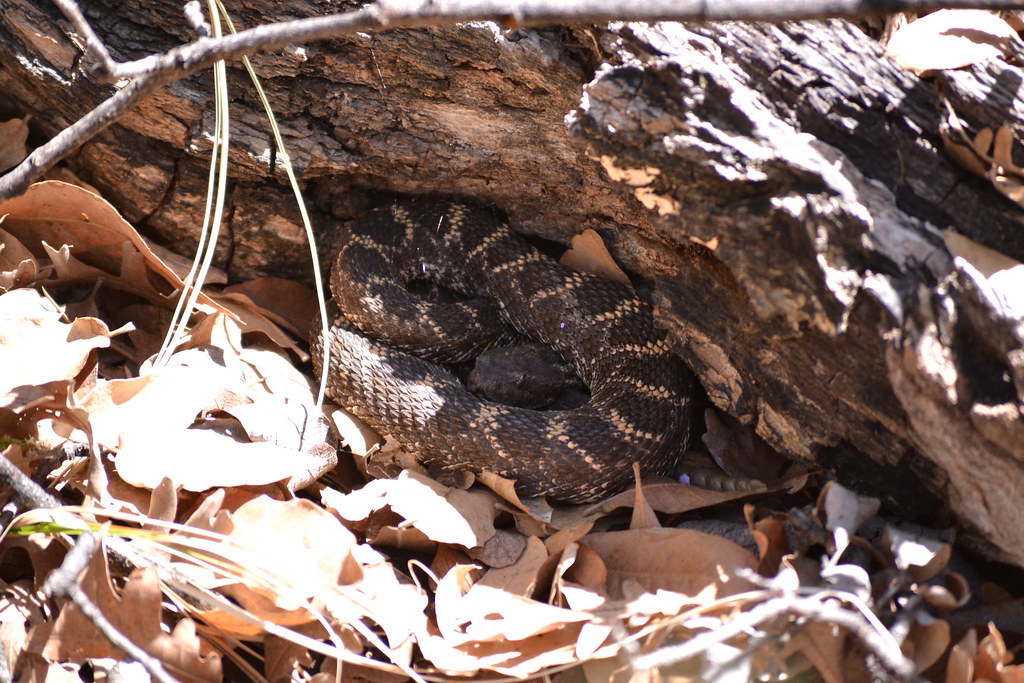
One of our favorite snakes of 2010 has been spotted at the den!  Alice was coiled next to a log a short distance away from the den the afternoon of 25 April:

Alice. 25 April 2011 13:40


And later heading away to her hunting grounds for this year:
Alice. 25 April 2011 16:13


Because she gave birth last year, it is unlikely that she will stick around the same area and give birth again this year.  Hopefully she'll be a successful hunter this year, and next year, more babies?


Alice 25 April 2011.  Not so happy to see us :-(

Zona

Wednesday, April 27, 2011

0 comments

*This story illustrates how we identify individual snakes and how important these aggregation sites are to the rattlesnakes.

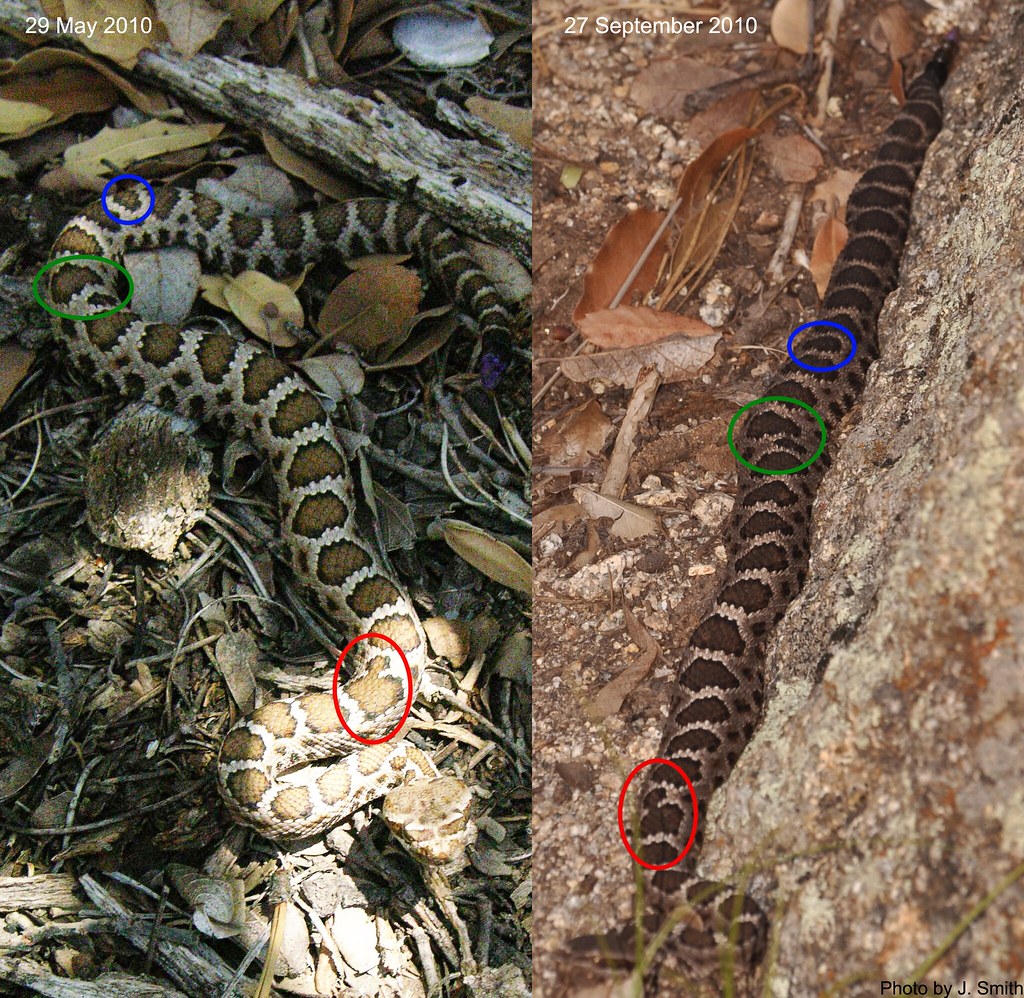
29 May 2010.  One the first snakes marked at this site was Zona, a female less than a year old when we first encountered her.


Zona 29 May 2010


Zona was sitting on a downed log a few meters from the den where many Arizona black rattlesnakes spend their winter, and two rookeries (where female rattlesnakes give birth to their young).  From the way she was positioned on the log, she was probably hunting for small lizards.  Zona was photographed and her rattle marked with purple paint so that she could be identified if we crossed paths again.


27 September 2010.  That fall, Zona was one of the first rattlesnakes to return to the den.  We found her on the opposite side of the den, stretched out along one of the large boulders.  Only a tiny bit of purple paint remained on her rattle, but several aberrancies in her pattern confirmed who this little was.


Zona, 29 May (left) and 27 September (right; photo by J. Smith) 2010. Like-colored circles indicate natural pattern aberrancies used to identify this snake.


Zona had nearly doubled in size over the intervening four months, but her dorsal blotches did not change in shape or number.  We took a small sample of blood to determine her relatedness to other rattlesnakes at the den and wished her well.


April 2011.  The rattlesnakes have just started basking at the den again and we've seen a few familiar faces, including Zona:


Zona, 23 April 2011, emerging from the den.  Can you see the same weird blotches circled in the photos above?

SuizoReport: Black Velvet

Thursday, April 21, 2011

0 comments

SuizoReport: Black Velvet: "A new religion that will bring you to your knees Black Velvet if you please........... Howdy Herpers, On 16 April, John Slone escorted ..."

Bandshell

Thursday, March 31, 2011

Halfway between Tucson and Phoenix, a crumbling granite hillside gives way to a cactus-studded alluvial plain. Small, sandy washes break up this landscape and facilitate the growth of desert trees. Here, the western diamondbacked rattlesnake flourishes during times of plenty and, in leaner times, retreats to refuges to idle until conditions improve.


In February of 2010 we discovered a number of rocky refuges used by western diamondbacks to spend the winter. These sites are treasured by generations of snakes for the protection offered from freezing temperatures, an arrangement of safe basking locations, and, perhaps, a rock surface that funnels a sprinkle of rain into a drinkable collection.

In mid-February of 2011, we visited to this area again to find that snakes had returned to most of these sites. One spot, in particular, intrigued us. Whereas last year it was found to house but one snake, it now contained several, perhaps even five snakes. We call it Bandshell, and it’s a small eruption of rock from the hillside with a deep, nearly vertical crevice into an inverted rock face.
We mounted a timelapse camera near the face of Bandshell in hopes that we would see how many snakes used this den this winter and perhaps get a glimpse of some emergence (‘egress’) behavior. We were more successful than we could’ve imagined.

25 February – 2 March 2011
With the exception of a weak storm front moving through on the 27th, the cameras record only a lack of activity by the snakes.

3 March 2011
Two young males, Scarecrow (S) and the Tin Woodsman (T) make their film debut.


These snakes engaged in combat, a ritualistic wrestling match whose outcome depends on which snake is better able to hold its opponent to the ground while intertwining. The victor may then be left to court a contested female.

Later that day, we return to swap data cards in the camera. About 5 m downslope of the den, we find T, stretched out amid brush and rocks. We are careful not to disturb him.


T enters the den at 1630, and S follows a quarter hour behind.


4 March 2011
A near repeat of yesterday. S slides out first with T following close behind.


This time, however, S appears reluctant to engage in combat.

T returns to the den at 12:48.


(Because of higher temporal resolution, the camera shuts off at 13:20 on 4 March)

6 March 2011
We arrive at 1000 and exchange memory cards. No snakes are evident outside the den.
T emerges and hangs around den.


S enters the den later that afternoon.


7 March 2011
Only T is active.


8 March 2011
T emerges, returns to the den, reemerges.


9 March 2011
No snake activity recorded.

10 March 2011
The warmest day so far this year brings some fresh characters.
The Cowardly Lion (C), a much larger male, emerges.


A female, Dorothy (D), emerges and coils at the entrance of the den.


T emerges and courts D. If you look carefully, courtship appears to continue just out of the frame in the upper left. At 1318, S emerges from the den, approaches the pair offscreen, and, apparently engages T in brief combat.


C crosses the frame.


T checks on the den.


C emerges from the den. S is not far behind.

T crosses the frame

A second female, Auntie Em (E), emerges.

We return to swap cards, but cannot do so without disturbing snakes around the den, so we postpone. E is still coiled at the entrance of the den.

S flanks the other side of the camera, about 2 m NE of the den entrance.

C returns to the frame to court E.


We return to find that S has vacated his post, and we take a chance on disturbing C and E, switching memory cards in the camera mostly hidden from their view. Although E is facing away, she appears to take a cue from C, who enters the den shortly after our departure.

About 20 m below the den, T sits in coil.

12 March 2011
The camera is now set to begin at 0800 rather than 0900, capturing the emergence of C.


E emerges and is soon joined by C.


At this point, the camera mysteriously shut off for 24 hours.


13 March 2011
E is visible coiled in the shade. C enters and courts her for 90 minutes, alternately chin rubbing and resting out of contact with her. Several times, as C rests, E moves her head slightly and appears to prompt him into another round of chin rubbing (e.g., at 14:58, 15:13, 15:28, 15:49).


14 March 2011
C is already out basking when the camera activates at 0800.


Later, T and one of the females emerge and interact. C returns, and the other snakes return to the den. C monitors then den, and at 09:53 E emerges, followed by T (10:05). E appears to be trying to re-enter the den as T vigorously courts her.


With E or T visible in the entrance to the den, C comes back and checks on the den several times., finally coiling in the shade to the left of the den entrance.


The next 90 minutes are obscured by the high contrast between areas in sun and shade, but at 12:24 the snakes are visible, with C out front, E (below) and T (above) in the den entrance.


15 March 2011
The only activity on this day is C posting up at the den entrance for a bit.


16 March 2011
Again, C is the only snake caught in the frame today as he checks on the den.


17 March 2011
A new snake, Oz (O) checks on the den. We think this snake overwintered at a different site.


18 March 2011
C checks on the den.


19 March 2011
Camera is taken down at 1000. Just a few meters downhill from the den, we discover E and C copulating.


SuizoReport: Stuck Up atrox Part 2 +

Wednesday, March 2, 2011

0 comments

SuizoReport: Stuck Up atrox Part 2 +: "Howdy Herpers, My good friend Melissa Amarello, AKA 'Cerbermiss,' has a most excellent website constructed around her work with Ariz..."

Serpent Research: More on Ending Rattlesnake Roundups

Wednesday, February 16, 2011

0 comments

Serpent Research: More on Ending Rattlesnake Roundups: "The following commentary was on the Andalusian Star News January 29, 2011 The City of Opp’s Rattlesnake Rodeo Web site cauti..."