Thanks for stopping by our blog! We are no longer updating this site, so if you want to see the latest from SocialSnakes, head on over to SocialSnakes.org where this blog is now hosted.

Ménage à trois (part 2)

Thursday, August 11, 2011

2 comments

(if you haven't already, see part 1)


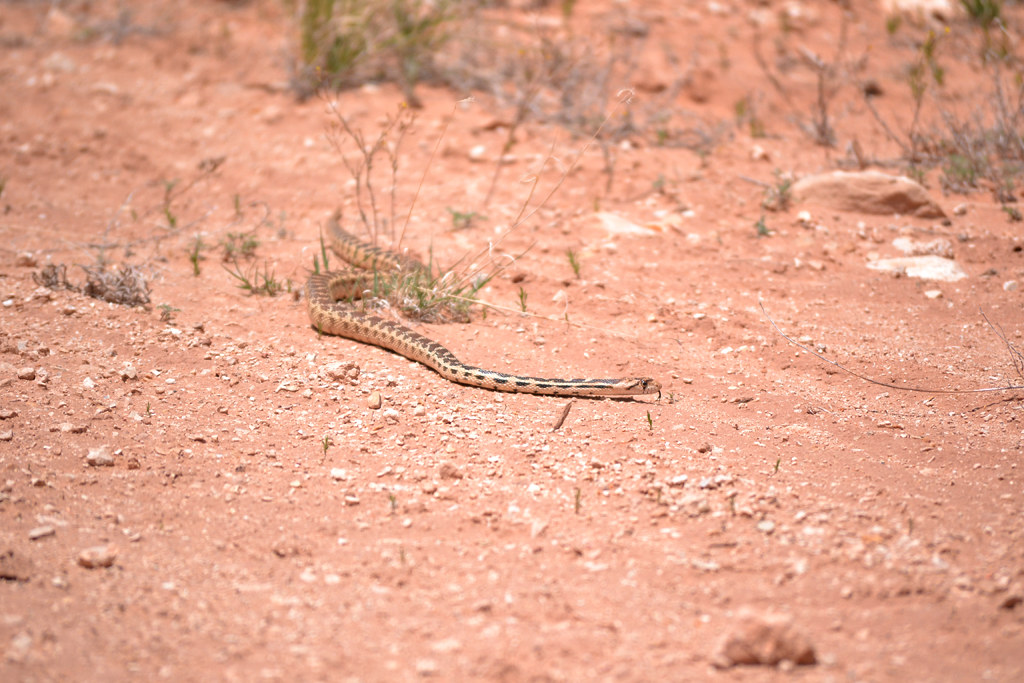
When we left our 3 gophersnakes, Bluto had just interrupted courtship between Popeye and Olive Oyl and was biting Popeye repeatedly along his body. Popeye released his bite-grip on Olive Oyl and she fled so fast that we were unable to follow. Bluto continued biting Popeye, making him to wince but not retaliate. Instead, Popeye seeks refuge in a nearby burrow. In his fervid biting, Bluto barely notices that Popeye has escaped, actually biting himself a couple times by mistake. Finally realizing that his competitor is sidelined, Bluto resumes searching for Olive Oyl, who had a 2 ½ minute head start.


Bluto appears to be in a hurry, and while he initially showed brief reactions to close encounters with us, he no longer expresses concern. He flicks his tongue almost continuously, halting almost imperceptibly several times a second to deliver particles into his mouth. Undoubtedly, Bluto is following traces of Olive Oyl, but apparently her trail is not clear. He travels in wide loops, backtracks, and even ascends a pine tree. Perhaps Olive Oyl has passed through this area more than once. And the wind must make his search even harder!

Popeye’s urges can wait no longer. We find him peering from the burrow only 3 minutes after entering. After five more minutes, he locates Olive Oyl’s scent trail, and heads off in the same direction as the other two.


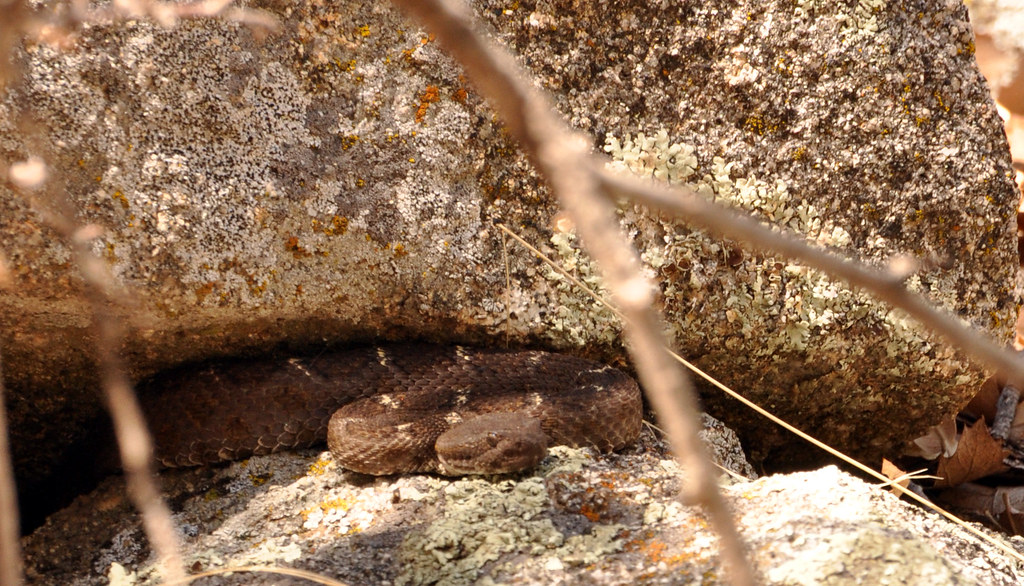
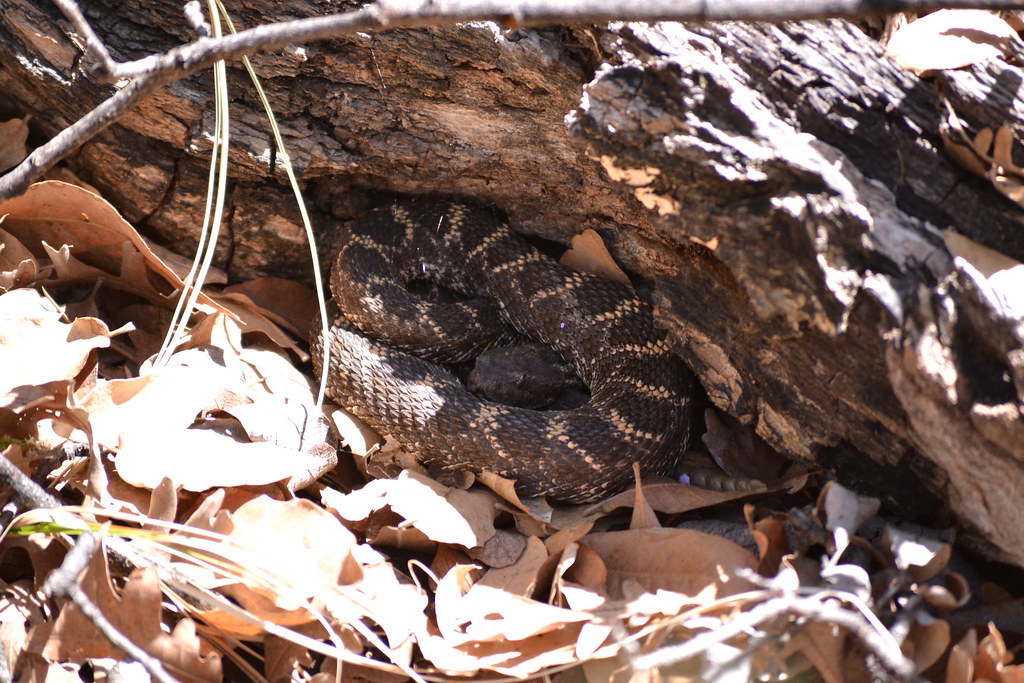
He appears to be a little more careful than Bluto, pausing to hone in on the path ahead. We try to keep tabs on both males as they move about, but we are distracted by a beautiful rattlesnake and Popeye slips away.
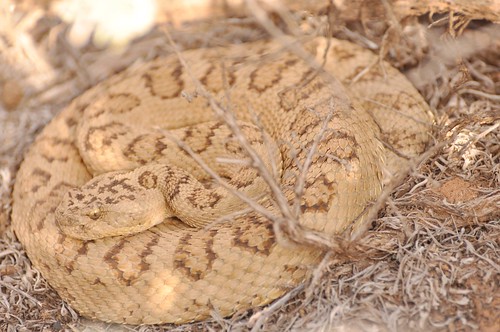
DSC_6448

After about an hour Popeye reappears, coming within just a few meters of Bluto. He appears to pass Bluto, and we again lose him as he cruises on through the vegetation. Finally, at 1417, 80 minutes after we last saw her, we find Olive Oyl being courted by Popeye on open ground beneath a tree, 113 meters NE of their roadside rendezvous (see part 1). Moments later, Bluto finds the pair, Olive Oyl slips away, and conflict begins anew.


In a repeat of part 1, Popeye is first to find and court Olive Oyl, but they are interrupted by latecomer Bluto, and the female flees. With an enduring calm, Popeye once again slips from Bluto's sway.


To be concluded...
Desert Dining

Thursday, August 4, 2011

1 comments

On a humid Sonoran Desert evening we met up with Roger Repp and Gordon Schuett at their study site along with some old friends from near and far. Wandering the washes, we find a juvenile desert rodent stumbling out of a hackberry bush into the dry stream channel. It turns at our approach and manages a couple of hops away before spiraling onto one side. While at first we attribute its ungainly locomotion to its youth or perhaps being blinded by a flashlight, it soon becomes clear: its situation is dire.


Six minutes after encountering the rodent, we spot a tiger rattlesnake (Crotalus tigris) emerge from the bushes about 10 meters downstream. It’s a beautiful male with a long, intact rattle, and he’s intent on finding his meal. This next video clip shows him scent trailing his prey.


Tiger rattlesnake venom is extremely potent, and this one knows his prey couldn’t get far. His search is slow but methodical; he may turn away momentarily, but he is quick to correct course and close in on his meal. In the following video, the tiger passes very close to the rodent, visible above the stick to the left. Portions of the film are sped up 3 times.


Observations like this are infrequently witnessed. By searching on foot, keeping our minds open to what may come, and being willing to sit and watch what unfolds were we able to observe this feeding event. That, and quite a lot of luck....

In the interest of full disclosure, this snake was captured after feeding. He is now being radio-tracked by Roger and Gordon, and further updates on this snake’s life will be available on Roger’s Suizo Report, posted regularly to John Murphy's blog: http://squamates.blogspot.com/p/roger-repps-suzio-report-page.html

Ménage à trois (part 1)

Wednesday, June 15, 2011

29 May 2011 – House Rock Valley – Northern Arizona

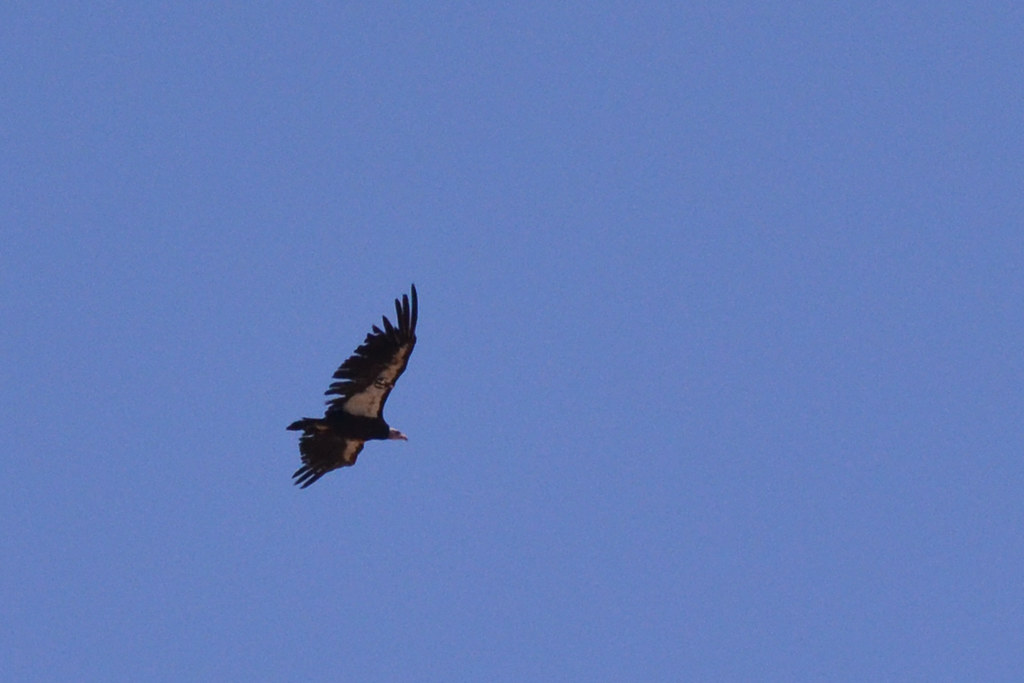
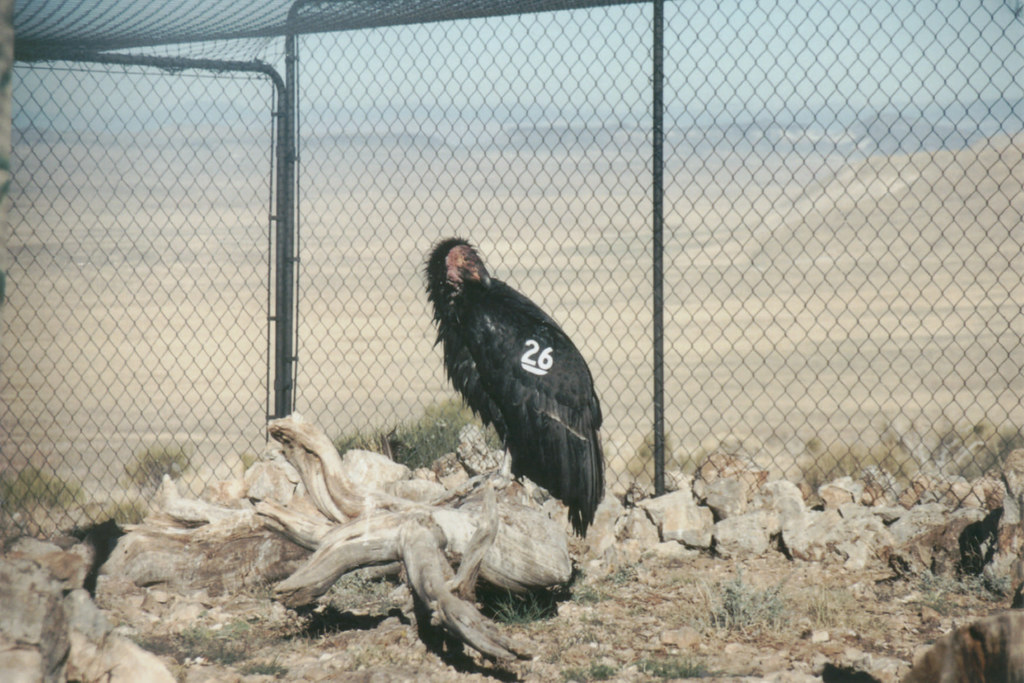
In 1996, The Peregrine Fund reintroduced California condors to northern Arizona. Once down to a mere 22 captives, there are now nearly 200 condors flying free in the southwestern US. We visited northern Arizona in hopes of finding snakes beneath soaring condors.

condor 126
condor in flight


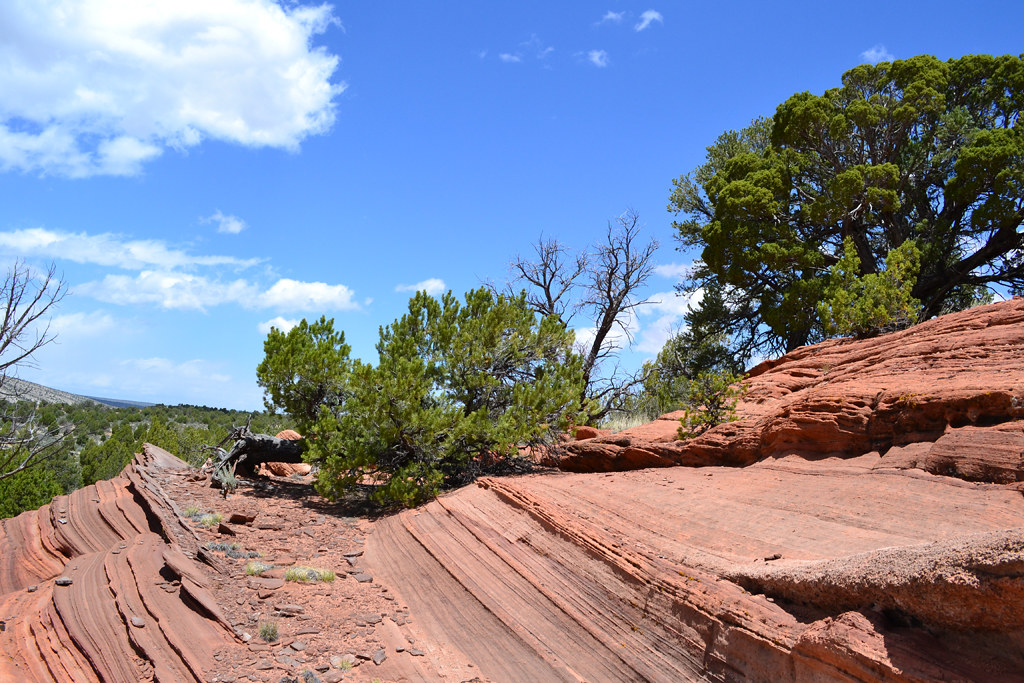
We learned of a trio of condors (2 males and a female) raising a chick in a cave overlooking House Rock Valley. Like Arizona black rattlesnakes, condors are social: they forage and roost in groups in which immature birds learn from experienced adults how to find food and appropriate resting sites. So it is perhaps not so unusual for a nest to have an "extra" adult male helper. We attempted to see this trio of nesting condors, but the wind howled so fiercely that we were barely able to fix a binoculared gaze on the cliffs above us. Besides, would an animal choose to be out in such unpleasant conditions? We thought not, and decided to find a place to explore that would shelter us from the wind. The valley bottom, with stands of juniper and islands of protruding sandstone, looked to be such a place.

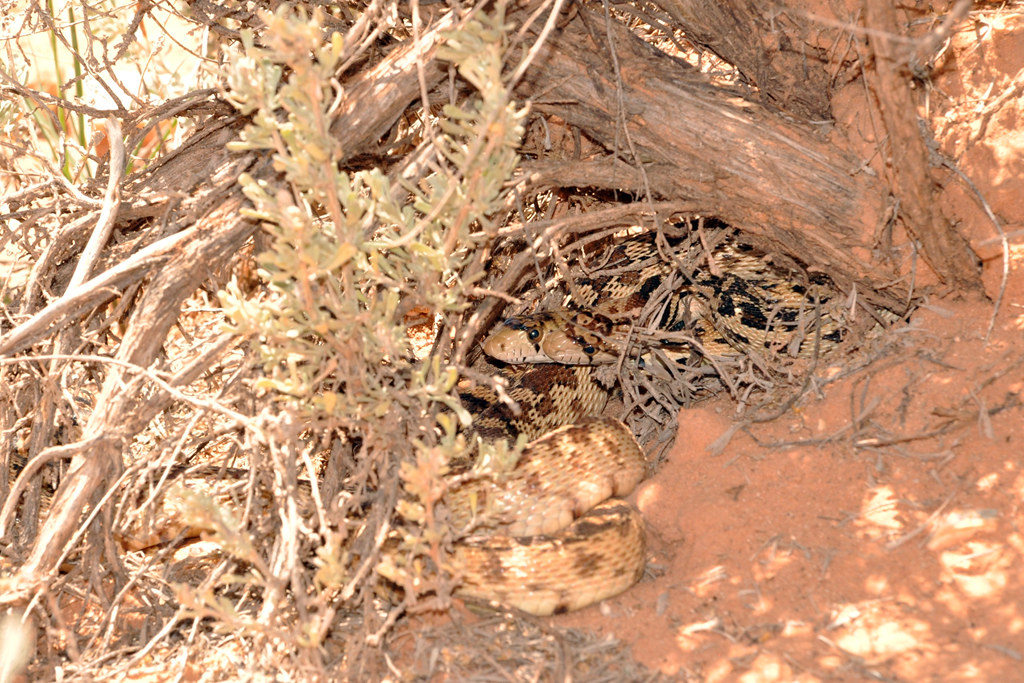
We followed a dirt road and arbitrarily selected a place to park. We threw on our packs and crossed the road, noticing a long, dark form on the road we’d just driven. We approached to find a gophersnake (let's call him Bluto) whose chocolate ladder of blotches contrasted beautifully against a pale yellow background color. Surely realizing his vulnerability, Bluto headed directly to a juniper at the road’s edge. By the time we drew our cameras, he had found a burrow and disappeared into it. Our lamentations of his escape were short-lived, because in an adjacent sagebrush lay not one but TWO gophersnakes. Given the season and the apparent amorous nature of their entanglement, we surmised they were a male and female pair (let's call them Popeye and Olive Oyl).


Olive Oyl maintains a wary eye while Popeye's attentions are consumed by his potential partner.


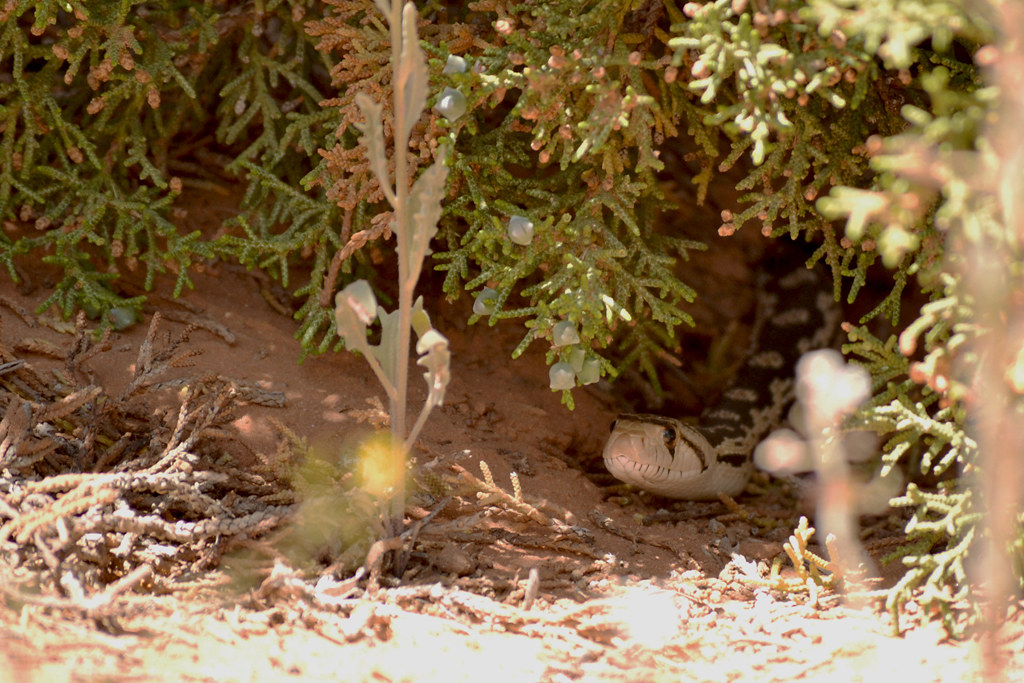
After three or four minutes, the couple tired of our presence and retreated into a burrow on the opposite side of the sagebrush. Surprisingly, Bluto was already making his comeback:


Bluto, the largest of the trio, assessing threats topside.

Rather than try our patience against reptiles, we decide to explore the area for a while and come back later.

habitat

After about an hour we make our way back to the gophersnakes. As we walk down the road toward the spot, we see Olive Oyl meandering through the roadside vegetation, about 10 m from where we initially found her. She turned as if to cross the road, but paused before entering the barren dirt roadway.

Olive Oyl

After a couple of minutes, Popeye came cruising through the same grass she’d just passed. We watched him make several wide loops, even coming within a couple meters of her before turning away. Meanwhile, after remaining motionless for several minutes, Olive Oyl turns and moves slowly from the road. Popeye finally comes upon Olive Oyl, grasping her with his mouth behind her head (see video at 0:41). Feeling vulnerable, perhaps because of our presence, Olive Oyl is able to slowly worm to what cover is afforded by a small shrub.


Bluto enters the stage from the same area as the other two, vaguely following the same path. We watch as he loops and circles, at times retracing his path backwards. He approaches the pair within a couple meters several times, and even passes by our feet, which gives him only momentary pause. Finally, his search is over.


Bluto immediately begins biting Popeye. Finally, Popeye is induced to release his grasp of Olive Oyl. Without delay she flees and we lose track of her. Although Popeye flinches and squirms with apparent discomfort from the biting he receives, he does not appear to retaliate in kind. He escapes the assault by disappearing into a burrow in the lower left quadrant of the frame. Once Bluto realizes his rival has fled, he turns his attention to Olive Oyl, following the exact path she used to escape the dispute.

To be continued....

Pretty in Pink

Wednesday, May 25, 2011

2 comments

28 April:  Molly basks briefly before leaving the security of the den to fulfill what is on every rattlesnake’s mind: the first meal of the year. It’s been over seven months since they’ve last had a chance to eat, so they’re probably quite hungry.


Molly comes out first and coils on the left. The snake on the right is Freckle, another young adult female.


Fortunately, they need not travel far, at least at first; there’s an abundance of lizards, birds, and small mammals active around the dens when the snakes emerge in spring. Molly first moves to a rock about 6 meters south of the den entrance and sits in an ambush posture for a couple of hours before retiring for the evening.

The next day, after basking in the morning sun, we find her moving among branches and rocks, and take the opportunity to swab some pink paint on her rattle using a telescoping fishing rod. Although we are able to use blotch pattern irregularities to identify individuals, a little paint on the rattle further facilitates future identification. She appears unperturbed by this, and continues her meandering to a rock several meters further from the den. Over the next two days we see Molly using the same rock for hunting by day and shelter by night.


7 May:  Molly is nowhere to be found. In the spot where Molly was last seen is the unmistakable reek of skunk. While humans may perceive rattlesnakes as fierce predators, they are killed and eaten by a variety of birds and mammals, including skunks. While waiting for her first meal, did Molly fall prey to a skunk?

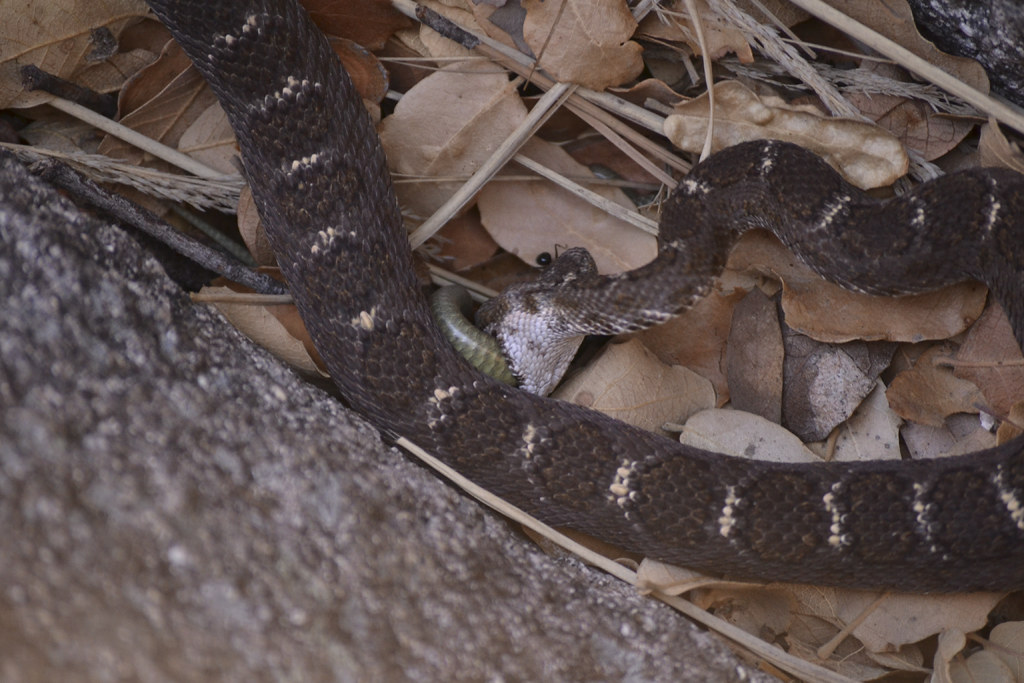
12 May:  We spot Molly on the west side of the den, stretched out in leaf litter, poking around in the leaves with her snout. At first the behavior seems quite unusual, but then we notice a long, smooth, tail poking out of the leaves.


We are then able to capture on video a rare observation of a snake feeding in the wild and thus document the first reported predation of a Gilbert’s Skink (Plestiodon gilberti) by an Arizona black rattlesnake.


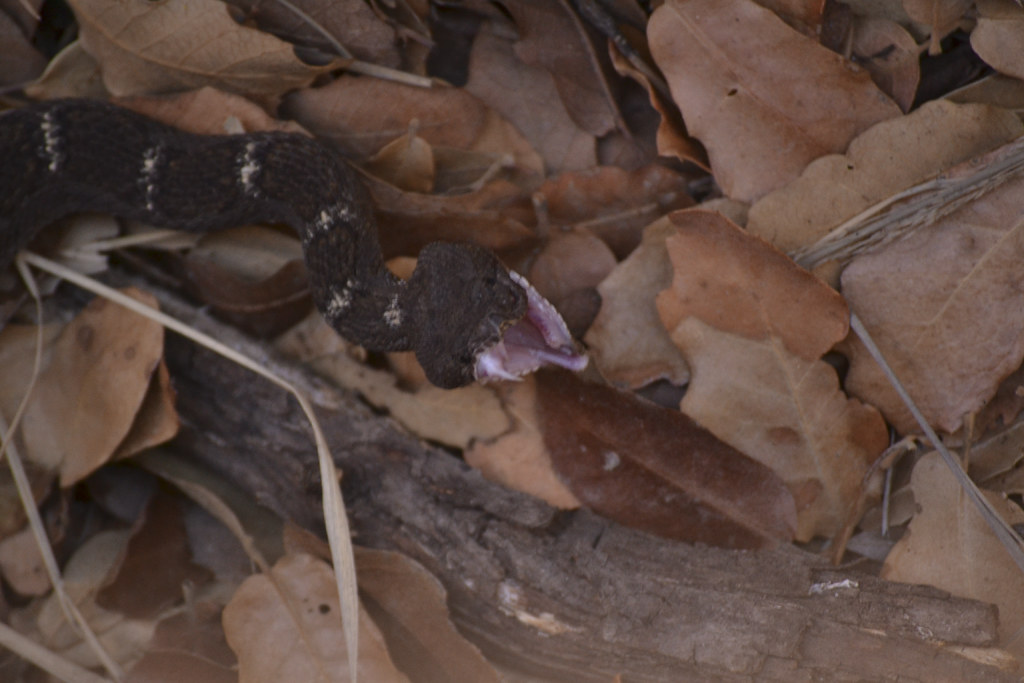
An after dinner yawn:


To see more pictures of Molly, click here

She's back: Alice!

Thursday, April 28, 2011

0 comments

One of our favorite snakes of 2010 has been spotted at the den!  Alice was coiled next to a log a short distance away from the den the afternoon of 25 April:

Alice. 25 April 2011 13:40


And later heading away to her hunting grounds for this year:
Alice. 25 April 2011 16:13


Because she gave birth last year, it is unlikely that she will stick around the same area and give birth again this year.  Hopefully she'll be a successful hunter this year, and next year, more babies?


Alice 25 April 2011.  Not so happy to see us :-(

Zona

Wednesday, April 27, 2011

0 comments

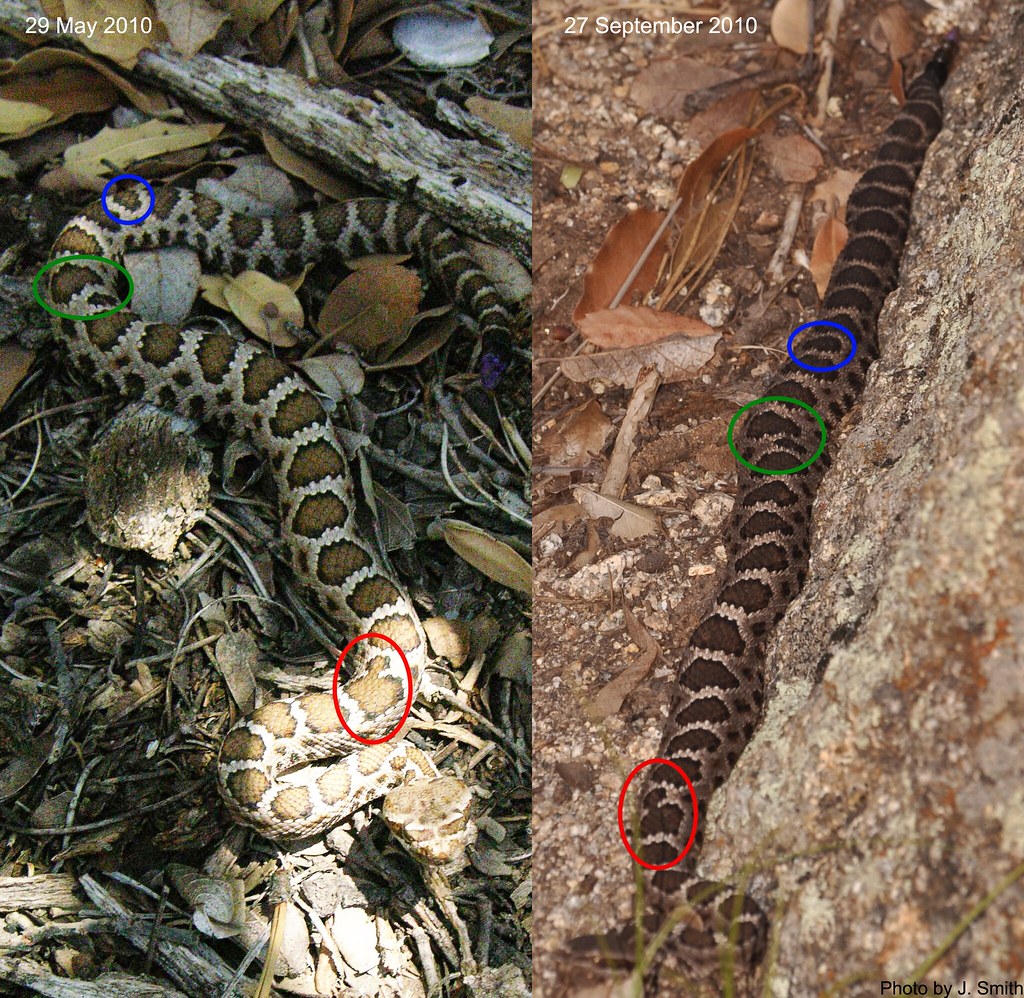
*This story illustrates how we identify individual snakes and how important these aggregation sites are to the rattlesnakes.

29 May 2010.  One the first snakes marked at this site was Zona, a female less than a year old when we first encountered her.


Zona 29 May 2010


Zona was sitting on a downed log a few meters from the den where many Arizona black rattlesnakes spend their winter, and two rookeries (where female rattlesnakes give birth to their young).  From the way she was positioned on the log, she was probably hunting for small lizards.  Zona was photographed and her rattle marked with purple paint so that she could be identified if we crossed paths again.


27 September 2010.  That fall, Zona was one of the first rattlesnakes to return to the den.  We found her on the opposite side of the den, stretched out along one of the large boulders.  Only a tiny bit of purple paint remained on her rattle, but several aberrancies in her pattern confirmed who this little was.


Zona, 29 May (left) and 27 September (right; photo by J. Smith) 2010. Like-colored circles indicate natural pattern aberrancies used to identify this snake.


Zona had nearly doubled in size over the intervening four months, but her dorsal blotches did not change in shape or number.  We took a small sample of blood to determine her relatedness to other rattlesnakes at the den and wished her well.


April 2011.  The rattlesnakes have just started basking at the den again and we've seen a few familiar faces, including Zona:


Zona, 23 April 2011, emerging from the den.  Can you see the same weird blotches circled in the photos above?

SuizoReport: Black Velvet

Thursday, April 21, 2011

0 comments

SuizoReport: Black Velvet: "A new religion that will bring you to your knees Black Velvet if you please........... Howdy Herpers, On 16 April, John Slone escorted ..."